



Yes, Telegram groups work for lead generation, but only when you treat them as a pipeline, not a megaphone. The best immediate tactic is this: find several niche groups where your buyers actually hang out, join as a real profile, and run a warm test with randomized delays before you send a single pitch.
Groups beat channels for outreach because they allow two-way conversation. Members can reply, react, and ask questions, while channels are strictly broadcast, one-to-many with no feedback loop. Telegram messages also see read rates between 70% and 90%, which is far higher than cold email typically pulls. That combination, high visibility plus a reply channel, is what makes Telegram group lead gen worth the setup effort.
Here's what to do in the next hour:
- Pick one niche and search for 15 to 20 active groups (not channels) where your prospects post.
- Join with a profile that looks like a real person, not a bare username.
- Draft one short, non-pitchy intro message you can send manually to five members before automating anything.
Key Takeaways
Telegram group lead gen works reliably when teams pair a disciplined five-step pipeline with anti-spam safeguards and a privacy-first export step into their CRM.
| Point | Details |
|---|---|
| Groups beat channels for outreach | Groups allow two-way replies; channels are broadcast-only and generate no qualification signal. |
| Follow the five-step pipeline | Acquire, engage, qualify, export, route, each with its own success metric to watch. |
| Warm accounts before automating | Randomize delays, rotate accounts, and cap daily sends to avoid FloodWait and ban flags. |
| Watch block rate as your stop signal | Pause scaling immediately if block or report rate climbs above a low, single-digit level. |
| Export privately before routing to CRM | Mastros' Telegram Scraper exports members, messages, and mutual groups locally in CSV, JSON, or JSONL, without uploading data to a server. |
Table of Contents
- What Is Telegram Group Lead Gen, and How Does the Playbook Work?
- How Do Bots, Userbots, and AI Agents Fit Into a Telegram Funnel?
- How Do You Design a Telegram Group That Actually Surfaces Leads?
- What Are Telegram's Rate Limits and Anti-Spam Rules for Outreach?
- How Do You Export and Qualify Telegram Group Members?
- What Do Ready-Made Telegram Automation Templates Look Like?
- What Do You Need Before Launching a Telegram Automation?
- How Do You Measure and Route Telegram Leads?
- What Does Telegram Lead Gen Look Like Across Different Industries?
- What Does Running This in Practice Actually Teach You?
- How Mastros Fits Into Your Telegram Lead Pipeline
- Sources
- FAQ
What Is Telegram Group Lead Gen, and How Does the Playbook Work?
Telegram group lead gen means using group membership, conversation, and reply behavior, rather than channel subscriber counts, to identify and convert prospects. The playbook underneath it has five steps: acquire, engage, qualify, export, route.
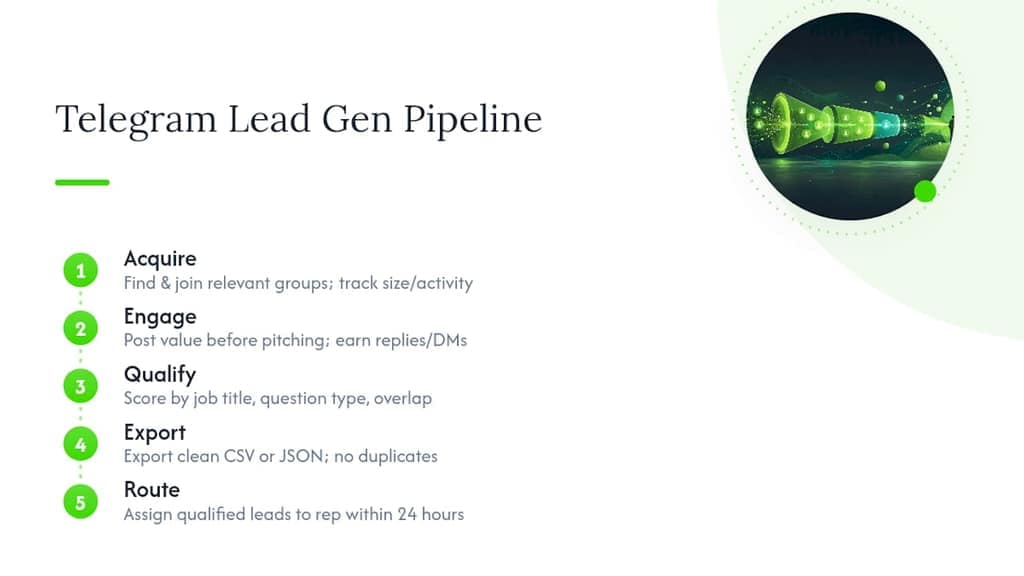
Acquire. Find and join groups where your ideal customer already talks shop. A recommended method treats this as a five-stage pipeline (niche → source chats → outreach → AI triage → follow-up), and one widely cited playbook points to a searchable index of roughly 2.9 million chats as a starting point for source discovery. Success here looks like adding a moderate number of relevant groups to a tracked list, each with a rough size and activity score.
Engage. Post value before you pitch. Answer questions, react to polls, share something useful. Success looks like at least a few organic replies or DMs within the first week, not silence.
Qualify. Not every active member is a lead. Success looks like a simple scoring pass (job title signals, question type, group overlap) that trims your list to the people worth a direct message.
Export. Pull the qualified names, usernames, and activity data out of Telegram into a structured file. Success looks like a clean CSV or JSON export with no duplicate rows and consistent fields.
Route. Push qualified contacts into your CRM with a clear owner and a follow-up deadline. Success looks like every qualified lead assigned to a rep within 24 hours.
In week one, test message-to-reply ratio and group-join acceptance rate before you touch automation. In week two, test your qualification filter against 50 real profiles and see how many survive. Only then should you wire in a bot or userbot.
Watch three numbers during any trial: reply rate, block or report rate, and the percentage of "leads" that actually match your ideal customer profile after a human reviews them. If block rate climbs past a low single-digit percentage of messages sent, stop and rework your cadence before scaling further.
How Do Bots, Userbots, and AI Agents Fit Into a Telegram Funnel?
Automation on Telegram runs in layers, and skipping a layer is usually what gets accounts banned. The stack looks like this: source discovery, an outreach sender (bot or userbot), an AI triage layer, a CRM or database, and a human handoff. Each stage has its own failure mode, and multi-stage pipelines that skip a stage either can't scale or get flagged fast.
A Telegram bot (built on the Bot API) is the safest option for structured, opt-in interactions like onboarding flows or FAQ triage inside a group you own. A userbot acts through a real user account via the Telegram API, which lets it join groups, read messages, and message people directly, but it also carries the most account risk if you send too fast or too often. An autonomous AI agent sits on top of a userbot, using a language model to read incoming replies and decide what to say next, which is powerful but needs strict guardrails.
One open example, TG Agent LeadGen, documents a production pattern for exactly this: an autonomous userbot that uses an OARS conversation method alongside FloodWait and PeerFloodError detection to reduce ban risk while engaging prospects.
- Use a bot when the interaction is structured and members opt in (welcome flows, FAQ menus, lead capture forms).
- Use a userbot when you need to initiate 1:1 conversations from a group context, but only with delays and volume caps in place.
- Use an AI agent on top of a userbot once you have a stable message template and you're ready to handle varied replies at scale.
A minimal workflow snippet looks like this conceptually: a scheduler triggers batches of messages per account per day, each with randomized delays, rotating across several warmed accounts, with every FloodWait error triggering an automatic cooldown rather than a retry.
Sending large volumes of identical messages quickly usually leads to bans, while sending fewer varied messages with random delays tends to maintain account health longer.
How Do You Design a Telegram Group That Actually Surfaces Leads?
Groups outperform channels for lead signals because members can talk back. A channel is one-to-many; a group is many-to-many, and that reply capability is where your qualification data comes from. The strongest setups pair the two: a channel for controlled narrative and a group for community and feedback, run in parallel rather than picking one.
Onboarding is where you either qualify members gently or scare them off. A welcome bot that asks one or two light questions ("What brings you here?" as a poll with three or four options) collects a qualification signal without feeling like an application form. Save the detailed questions for later, once trust is built.
Once members are in, engagement mechanics decide whether you get real signal or just noise. Polls surface intent cheaply. AMAs surface pain points in members' own words. Public recognition (shoutouts, "member of the week") pulls your most engaged people into visible conversation, which makes them easy to spot and easy to DM.
Pro Tip: Track poll participation and repeat commenters separately from total member count. A group of 400 with 40 regular contributors is worth more to your pipeline than a group of 4,000 that never talks.
Total subscriber count is a vanity number. The lead signal lives in who answers your polls, who shows up twice, and who opts into a DM.
What Are Telegram's Rate Limits and Anti-Spam Rules for Outreach?
Telegram doesn't publish a single universal message cap, but the behavioral patterns that trigger restrictions are well documented across practitioner playbooks. The core anti-spam principles are warmup, randomized delays, account rotation, and proxy or IP segmentation when running multiple accounts.
Warmup means a new account spends its first one to two weeks acting like a normal user: joining a handful of groups, reacting, occasionally commenting, before it sends a single outbound message. Randomized delays mean no fixed-interval sending; a script that fires every exact 45 seconds looks like a bot even if a human wrote the message. Anti-ban practices like these lower risk, but they never eliminate it entirely, so pair them with active monitoring.
- Cap outbound messages per account per day, starting low (well under 20) and scaling only after a clean week.
- Randomize delays between sends, ideally minutes rather than seconds.
- Rotate across multiple warmed accounts instead of hammering one.
- Segment accounts across separate proxies or IPs when running more than two or three in parallel.
- Watch for FloodWait errors, PeerFloodError responses, and any USER_BANNED flags as hard stop signals.
Pro Tip: A single account getting a temporary FloodWait is normal friction. Multiple accounts getting flagged from the same group in the same week is a different problem, it usually means the group itself is watching for outreach patterns, not that your delays are wrong.
How Do You Export and Qualify Telegram Group Members?
Capturing lead data cleanly starts with deciding what fields actually matter before you export anything. A minimal lead schema includes: name, username, user ID, mutual groups, last activity timestamp, and a sample message. Each field earns its place.
- Name and username give you the identity to search and verify against LinkedIn or a company directory.
- User ID is the stable identifier Telegram itself uses, which matters because usernames can change.
- Mutual groups show shared context, and members who show up in two or three of your target communities are a warmer signal than a cold join.
- Last activity tells you whether the account is alive or dormant.
- Sample message gives your sales team real language to reference in a follow-up, instead of a generic opener.
Once you've defined the schema, the capture pattern is straightforward: open the group's member list, scroll to load the full roster, run your export tool, then dedupe against your existing CRM records before anything gets routed to a rep.
| Export Format | Best For | Notes |
|---|---|---|
| CSV | Spreadsheet review, quick CRM import | Easiest for non-technical teams to open and filter manually |
| JSON | API-based CRM integrations | Preserves nested fields like mutual groups cleanly |
| JSONL | Streaming into automation tools (n8n, Zapier-style flows) | One record per line, ideal for batch processing |
For most agencies, CSV is the fastest path into a spreadsheet or a basic CRM import, while JSON or JSONL suits teams piping data straight into an automation platform. A browser-based tool like Mastros' Telegram Scraper handles this capture step locally, exporting members, mutual groups, and recent messages without uploading anything to an external server, which matters if your legal or compliance team has opinions about where prospect data lives. Because mutual group overlap is one of the warmest signals available in Telegram data, it's worth capturing even when you're not ready to act on every contact yet.

What Do Ready-Made Telegram Automation Templates Look Like?
You don't need to build an automation stack from scratch. Two categories of template cover most use cases: visual workflow builders and code-based agent frameworks.
An n8n workflow for this pipeline typically runs in five connected nodes: parse incoming group data, send the initial outreach message, receive and log the reply, run it through an AI triage step (classifying interest as hot, warm, or cold), and push qualified results into your CRM. Because n8n is self-hostable, teams that care about data residency can run the entire pipeline on infrastructure they control.
For the conversation logic itself, the TG Agent LeadGen pattern uses what its documentation calls the OARS method, a structured approach to reading a prospect's reply, classifying its intent, and generating a response that moves the conversation forward without sounding scripted. A simplified configuration excerpt looks like this conceptually:
- Trigger: new direct message received from a group contact.
- Cooldown: minimum delay enforced between consecutive sends per account.
- Ban-check: automatic pause and retry logic on any FloodWait or PeerFloodError response.
- Escalation: any reply flagged "hot" gets pushed to a human within the hour instead of continuing through the bot.
A template is a starting point, not a finished system. The teams that get the best results treat the AI layer as a filter that finds the warm conversations, then hand those conversations to a person the moment intent looks real.
Keep your message variations genuinely different, not just synonym swaps of the same sentence, since repetitive phrasing across accounts is one of the easier patterns for spam detection to catch. Use media (images, short voice notes) sparingly and only where it fits the conversation naturally. And build in an explicit rule: once a reply shows clear buying intent, automation stops and a human takes over the thread.
What Do You Need Before Launching a Telegram Automation?
Before any of this goes live, a short technical and operational checklist saves you from the most common failure points.
On the technical side, you need an API_ID and API_HASH from Telegram's developer portal, a working phone authentication flow for each account you'll operate, an API key for whichever language model powers your triage layer, secure session storage for each authenticated account, and, if you're running more than one or two accounts, proxies to segment their traffic.
On the operational side, you need a documented account warmup plan (how long, what activity, before outbound starts), explicit throttling rules written down somewhere your team can reference, and a daily monitoring routine, even a simple spreadsheet, that tracks error rates and flags.
Store session files and API keys locally or in an encrypted secret manager you control, never in a plain-text file committed to a shared repository. A leaked session file is functionally the same as handing someone your logged-in account.
How Do You Measure and Route Telegram Leads?
The KPIs that matter most are delivery rate, read rate, response rate, positive response rate, conversion rate, and block rate. Read rates on Telegram commonly land between 70% and 90%, so if yours is dramatically lower, your targeting or account health likely needs attention before your messaging does.
Your minimal CRM field set should mirror the export schema: name, username, user ID, source group, mutual groups, triage score, and last contacted date. A simple routing rule that works for most teams: any reply your AI triage scores as "warm" or "hot" gets a human follow-up within 24 hours, while "cold" replies stay in a nurture sequence.
| Metric | Measurement Method | Healthy Target |
|---|---|---|
| Read rate | Messages read ÷ messages sent | 70 to 90 percent |
| Response rate | Replies received ÷ messages sent | Track weekly, watch for sudden drops |
| Block rate | Blocks or reports ÷ messages sent | Keep as low as possible; stop scaling if it climbs |
| Human follow-up SLA | Time from "hot" tag to rep contact | Under 24 hours |
Tracking these numbers in a spreadsheet works for a small trial, but once you're running multiple groups and accounts, dedicated Telegram data analytics makes the pattern spotting a lot less manual.
What Does Telegram Lead Gen Look Like Across Different Industries?
The mechanics stay the same across verticals, but the messaging and qualification bar shift depending on what you're selling.
- SaaS teams often source leads from developer or niche-tool groups, using technical questions in the chat as a qualification signal; a good result looks like a handful of qualified demo bookings per week from an actively managed group.
- Course creators use their own paid or free community group as the funnel itself, converting engaged members (poll responders, repeat commenters) into buyers through direct, personal outreach rather than automation.
- Event organizers run a group tied to a specific event or series, where qualification is almost automatic (anyone asking about dates or tickets is warm), and conversion tends to spike in the week before the event.
- Real estate and local service businesses use geography-specific groups, where mutual group overlap and local activity matter more than message volume.
Telegram tends to work best as an acquisition channel when your buyer already congregates in niche, topic-specific chats. Telegram functions better as a retention and conversion layer than a pure discovery engine, so if your buyers aren't already active there, your owned email list or paid channels are probably still the faster path.
What Does Running This in Practice Actually Teach You?
The most common pitfall isn't a technical one, it's treating Telegram like a mass-email list. Teams that copy their cold-email cadence straight into a userbot burn through warmed accounts in days and wonder why block rates spike. The correction is almost always the same: slow down, vary the message, and let the AI triage layer do less talking and more listening.
Templates like the n8n workflow and the TG Agent OARS pattern referenced above are a starting architecture, not a finished product. Every team that's run this successfully has rewritten the triage prompts and adjusted the delay windows to match their own niche's tolerance for outreach.
If you're launching your first campaign, the single most practical takeaway is this: run your first 100 messages manually or semi-manually before you automate anything. You'll learn more about what "warm" actually sounds like in your niche from those 100 replies than from any template.
How Mastros Fits Into Your Telegram Lead Pipeline
Mastros is the privacy-first alternative to uploading your Telegram contact data to a third-party server just to get it into a CRM. The Telegram Scraper runs directly in your browser, exporting group members, chat messages, recent contacts, mutual groups, and bulk media without sending anything off your machine, which matters once you're handling hundreds of qualified prospects instead of a handful.
It plugs into the pipeline right at the export step: capture your qualified members from a group, export to CSV for a quick spreadsheet review or JSON/JSONL for a direct CRM or n8n import, then route from there. Teams running higher-volume campaigns can turn on Power Mode, which connects through your own Telegram API credentials for faster, more complete exports.
If you're running Telegram and WhatsApp campaigns side by side, the WhatsApp Scraper covers the same read-only export need on that platform. Install the Telegram Scraper, run it against one of your active groups today, and see how a clean export changes your routing speed.
Sources
- Telegram FAQ
- Telegram Marketing Guide for Startups: Channels, Bots & Conversion (Part 1) | Sam Shev
- Telegram Marketing Strategy: A Complete Framework for 2026 | BrandGhost
FAQ
Does Telegram pay creators per 1,000 views?
Telegram's ad revenue sharing program pays channel owners a share of advertising revenue tied to views on their channel, but figures vary by region and are set within Telegram's own ad platform rather than a fixed public rate, so check Telegram's official terms for current numbers rather than a secondhand estimate.
Is 18+ content allowed on Telegram?
Telegram allows some adult content but restricts it through age-gating and platform policies that vary by content type and jurisdiction; for lead-gen purposes, sticking to professional, policy-compliant content protects your accounts from unrelated bans.
How much do Telegram Stars cost?
Telegram Stars pricing is set by Telegram and varies by purchase quantity and platform, so confirm current pricing directly inside the Telegram app rather than relying on a fixed figure, since in-app digital goods pricing changes over time.
How do I spot a scammer in a Telegram group?
Common red flags include unsolicited DMs promising guaranteed returns, pressure to move the conversation off-platform immediately, and profiles with no group history or mutual connections. Checking mutual groups and message history before responding, which a tool like Mastros' Telegram Scraper can surface in bulk, is a quick way to separate real prospects from bad actors.

Should I use a bot or a userbot for Telegram lead gen?
Use a bot for structured, opt-in interactions like onboarding inside your own group, and a userbot only when you need to initiate 1:1 conversations, with strict delay and volume limits in place to avoid triggering FloodWait or ban flags.